
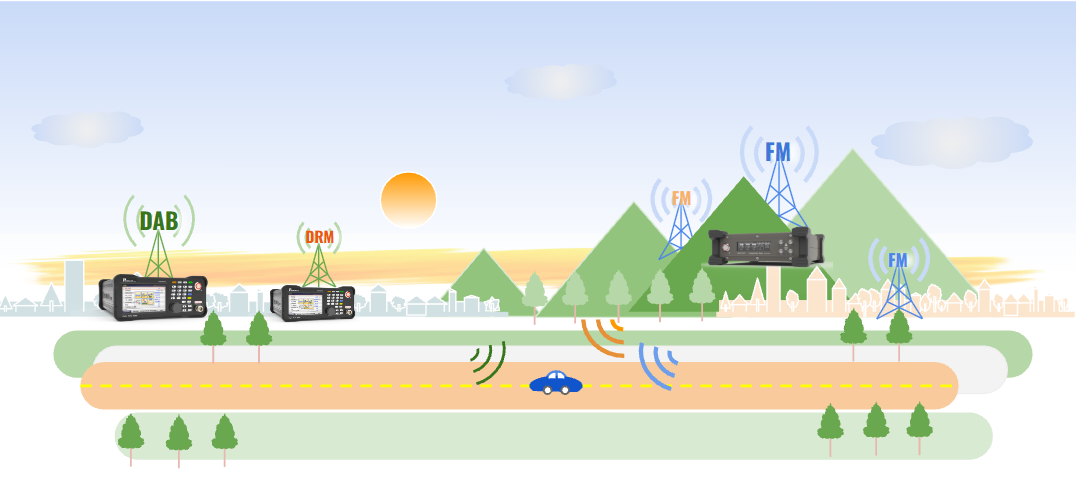
Modern in-vehicle infotainment (IVI) and radio receivers must deliver seamless, high-fidelity audio despite changing RF reception. As vehicles travel between urban and rural areas, coverage shifts across DAB/DAB+, DRM/DRM+, and FM-RDS networks.
To prevent dropouts or audio gaps, receivers use Service Following and Service Linking protocols, such as:
- Alternative Frequency (AF) signaling in RDS
- FIG 0/21 and FIG 0/6 in DAB
- SDC frequency signaling in DRM
When a digital signal weakens, the receiver evaluates alternative carriers and performs time-aligned audio blending (such as DAB-to-FM or DRM-to-DRM). Verifying these handovers requires test environments that accurately simulate multi-transmitter RF fields, multi-standard signaling, and inter-transmitter audio phase offsets.
The Challenge of Automotive Service Linking Verification
Simulating real-world broadcast linking in an R&D lab presents several key engineering challenges:
- Signaling Complexity: Configuring multi-transmitter Alternate Frequency (AF) signaling requires building complex cross-referencing tables across multiple standards, such as AF_DAB_TO_DAB, AF_SVC_TO_RDS, and AF_SVC_TO_DRM trees.
- Audio Time Alignment: Processing latencies and propagation distances create time offsets between identical programs broadcast on DAB and FM. Testing receiver buffer management and seamless blending requires sub-second audio delay control across multiple sources.
- Dynamic RF Profiles: As vehicles move between base stations, signal strength fluctuates continuously. Manually recreating these dynamic RF gradients across separate signal generators is labor-intensive, error-prone, and hard to reproduce.
Solution Overview: RedwoodComm Service Linking Test Tool (SLTT)
The RedwoodComm Service Linking Test Tool (SLTT) combines hardware-accurate RF signal generation with an intuitive, automated PC interface.
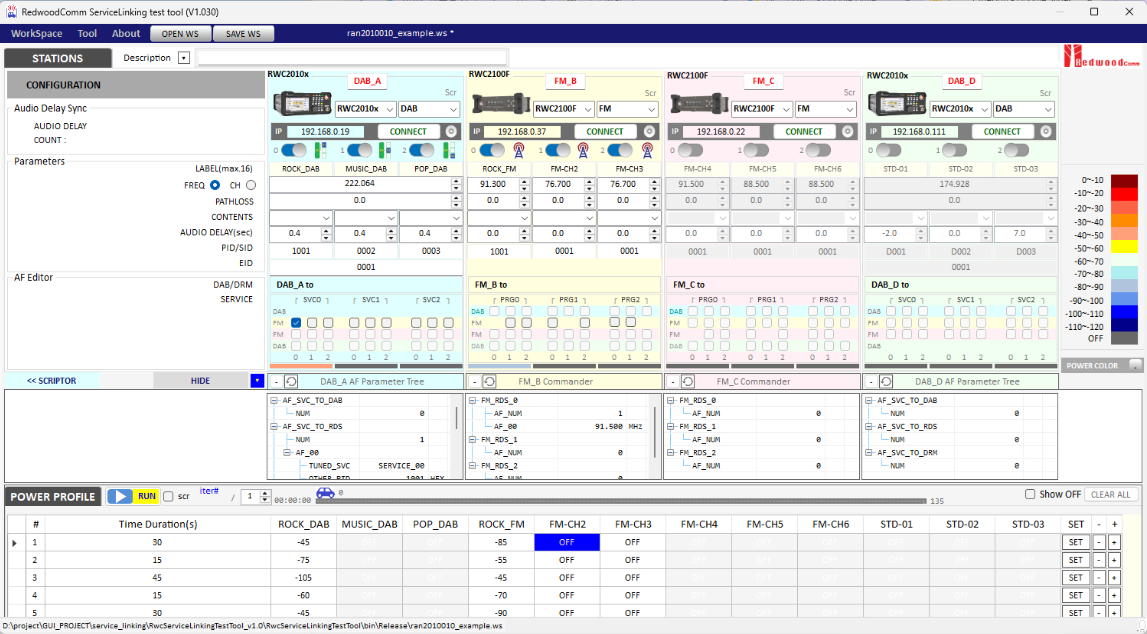
- Scalable Multi-Tester Orchestration: SLTT controls multiple instruments simultaneously over Ethernet. Using flexible RWC2010C units—which include built-in FM capabilities—it replaces legacy multi-transmitter setups with a streamlined, multi-standard architecture.
- Flexible Signal Combinations: Generate up to four DAB ensembles, DRM multiplexes, or multi-channel FM signals, or run any hybrid combination needed for complex service linking tests.
- Automated Hardware Setup: The software automatically detects connected units via
*IDN?queries, identifies platform capabilities, and configures the user interface to match.
Practical Application Scenario: Simulating a Real-World Drive Test
Example Scenario: Seamless DAB-to-FM Linking
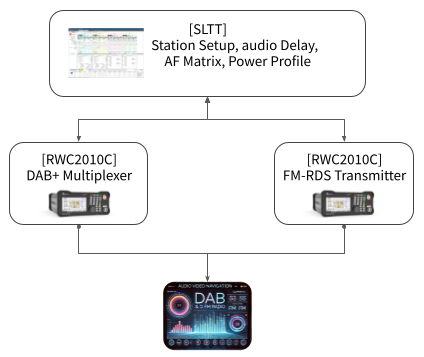
Key Benefits & Summary
Combining the Redwood Service Linking Test Tool with RWC2010C platforms streamlines automotive broadcast receiver verification:
- Accelerated Time-to-Test: Cuts multi-standard linking test setup from hours of manual scripting down to minutes of configuration.
- High Reproducibility: Delivers consistent RF fading and delay scenarios for reliable benchmarking across firmware releases.
- Cost-Effective Scalability: Scales modularly with additional RWC2010C units to support complex multi-frequency, multi-standard setups.