

By Creanord
The days of relying solely on legacy TETRA networks are coming to an end. For decades, TETRA has been the backbone of mission-critical communications, delivering dependable voice services for first responders and public safety agencies. However, these systems were never designed to support the data-intensive requirements of modern applications. As digital transformation accelerates, operators worldwide are transitioning to resilient, high-capacity 4G and 5G architectures to future‑proof their operations.
This evolution unlocks a new generation of capabilities. From augmented reality to enhance firefighting operations and remote eHealth diagnostics, to drone‑based situational awareness and real‑time group video collaboration, broadband communications are transforming how mission‑critical agencies operate in the field.
A Defining Shift for Mission‑Critical Communications
By 2026, the scale of this transformation is clear. Sweden’s move toward the Swedish Emergency Network (SWEN) exemplifies the industry’s direction. With the legacy Rakel system scheduled for retirement by 2030, SWEN introduces a hybrid model that combines a state‑controlled core network with commercial 4G and 5G mobile networks.
This architecture delivers nationwide coverage while enabling advanced broadband services. At the same time, it introduces a crucial challenge: ensuring uncompromised service assurance across shared, hybrid infrastructures. When lives depend on communications, availability and performance are non‑negotiable.
The Hybrid Challenge: Service Assurance Is non-Negotiable
As critical communication network providers migrate from TETRA to commercial 4G/5G technologies, the new environment must meet — or exceed — the reliability standards of legacy systems. Traditional network monitoring tools fall short in this context. What is required is an advanced, end‑to‑end service assurance platform that delivers deep visibility across the entire service chain.
In hybrid deployments, mission‑critical traffic traverses both commercial radio access networks (RAN) and government‑controlled core systems. To maintain service integrity, operators must monitor performance across four distinct network segments:
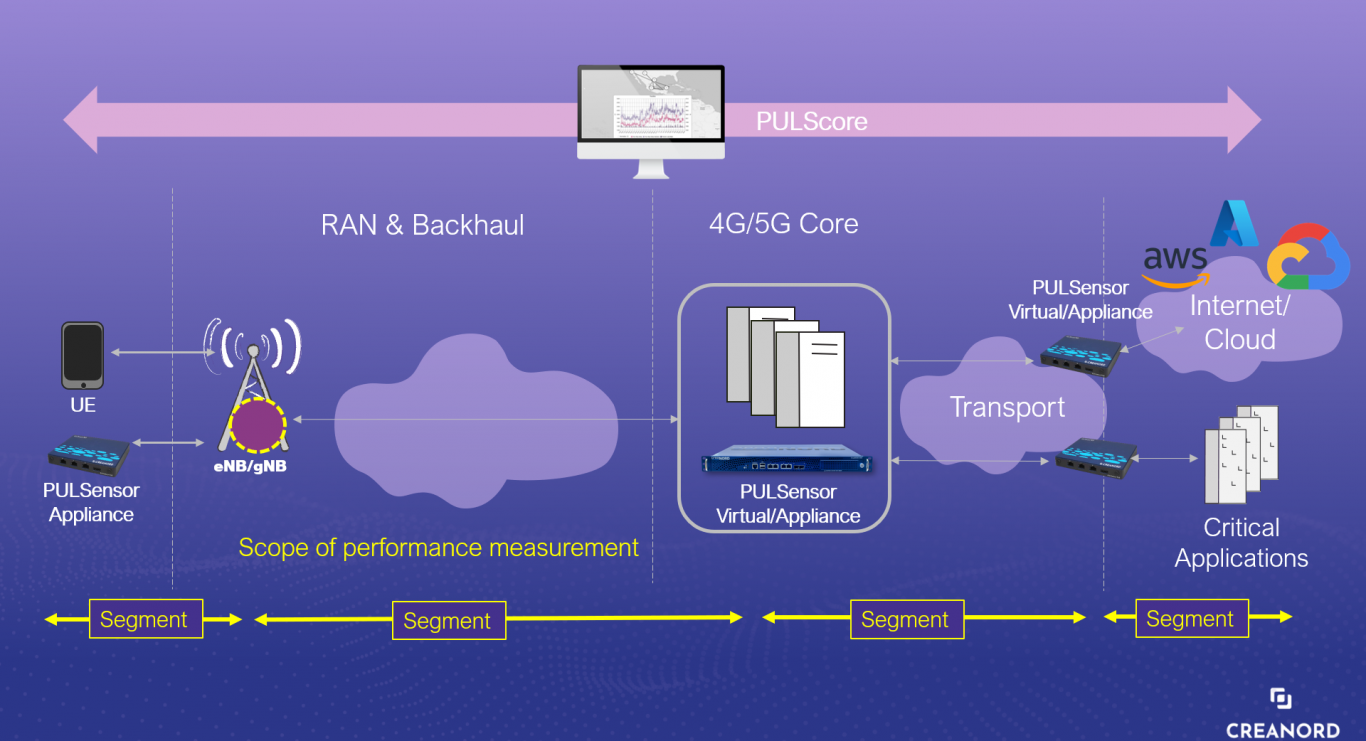
- User Equipment to Base Station (Radio Performance)
Radio coverage remains one of the most common sources of service degradation. Commercial RANs are typically optimized for densely populated areas where consumer demand is highest. Mission‑critical users, however, require consistent performance everywhere — from city centers to remote rural locations.
By leveraging end‑user devices to actively measure radio and application performance, operators gain essential insight into real‑world coverage conditions. This visibility enables constructive collaboration with RAN providers to identify coverage gaps and resolve service issues before they impact operations.
- Base Station to 4G/5G Core (Mobile Backhaul)
In a hybrid model, mission‑critical traffic often shares backhaul infrastructure with commercial data services. Although prioritization mechanisms are in place, performance can still vary across mixed fiber and radio links.
To mitigate this risk, operators must establish clear monitoring agreements with RAN providers. Using tools such as TWAMP and enabling reflection features on base station routers, agencies can continuously measure latency, loss, and jitter — gaining accurate, real‑time insight into backhaul performance directly from the core network.
- Internal Transport Network
Many critical communication providers operate their own transport networks connecting 4G/5G core sites to applications hosted in private data centers, public clouds, or on the open Internet. These networks were often designed for legacy traffic patterns and may struggle with bandwidth‑heavy services such as live video streaming.
Deep visibility into this segment allows operators to proactively identify congestion, plan capacity upgrades, and prevent emerging bottlenecks from affecting end users.
- Connectivity to Critical, Public Cloud, and Internet Applications
True end‑to‑end assurance extends all the way to the application layer. Whether applications are hosted in the public cloud, on the Internet, or within secure private environments, monitoring their performance is essential.
By correlating application‑level metrics with transport and radio‑network data, operators can pinpoint the root cause of service degradation and resolve issues quickly and accurately.
Embracing the Future with Confidence
The global transition from TETRA to 4G/5G‑based mission‑critical networks is well underway, promising powerful new use cases and operational efficiencies. Success, however, depends on more than adopting new technology. It requires a proactive approach to service assurance — ensuring that operators have the visibility, insights, and tools needed to prevent performance issues before they occur.
As countries such as Sweden and Finland lead the way into the resilient 5G era of mission‑critical communications, ensuring these vital lifelines remain reliable has never been more important.